As the global freight industry grapples with the limitations of battery-electric range, Volvo Trucks is looking toward a familiar mechanical solution with a sustainable twist. The company has officially commenced on-road testing of heavy-duty trucks powered by hydrogen-fed internal combustion engines. This move is part of a broader “three-path” strategy to reach net-zero emissions, positioning hydrogen combustion as a vital bridge for regions where charging infrastructure remains a significant hurdle.
The core of Volvo’s hydrogen solution is the High Pressure Direct Injection (HPDI) technology. Developed in partnership with Cespira, HPDI allows for compression ignition by injecting a small amount of “ignition fuel” at high pressure before the hydrogen is added.
This approach differs from other hydrogen combustion technologies that often struggle with efficiency. Volvo claims its HPDI system provides higher energy efficiency, lower fuel consumption, and increased engine power compared to conventional hydrogen engines. Because the technology is derived from Volvo’s existing diesel and gas-powered powertrains, of which over 10 000 units are already in global operation, the company is promising a driving experience that mirrors traditional diesel trucks in terms of torque and drivability.
Under the recently agreed-upon EU CO2 emission standards, these hydrogen-powered trucks are officially categorized as “Zero Emission Vehicles” (ZEV). While they do utilise a combustion process, the use of green hydrogen significantly slashes tailpipe output. Furthermore, when renewable HVO (Hydrotreated Vegetable Oil) is used as the ignition fuel, the vehicles have the potential to deliver net-zero CO2 on a “well-to-wheel” basis.
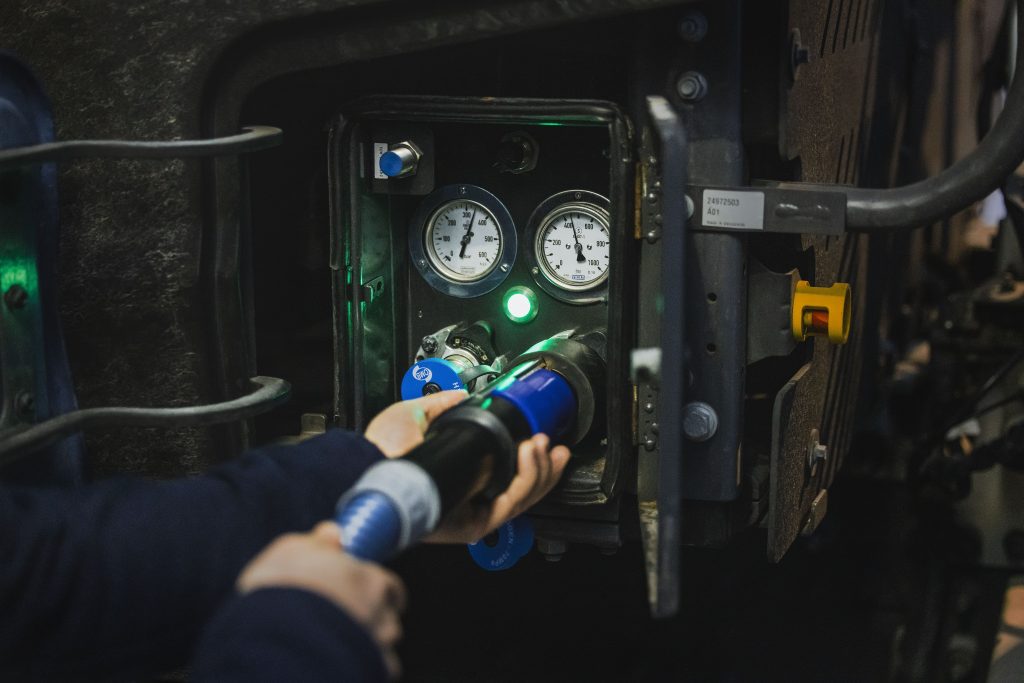
This classification is a major win for logistics companies operating in Europe and other strictly regulated markets, as it allows them to meet decarbonisation targets without the downtime associated with recharging massive battery arrays.
Volvo is clear that hydrogen combustion is not a “silver bullet” but rather a complementary piece of a larger puzzle. The company’s strategy for reaching net-zero involves three distinct technologies: Battery-Electric for or short-to-medium urban and regional hauls. Fuel Cell Electric, where electricity is produced on-board using hydrogen to emit only water vapour. Lastly, Renewable Fuel Combustion which uses hydrogen, biogas, or HVO in internal combustion engines.
Jan Hjelmgren, Head of Product Management at Volvo Trucks, notes that this variety is essential because different transport assignments require different infrastructure. Hydrogen combustion is specifically aimed at long-distance routes and areas where the power grid cannot yet support the high-megawatt charging required for heavy-duty electric fleets.
While specific mileage figures were not disclosed, Volvo confirms that the operational range of these trucks will exceed the daily driving distance of many of its current customers. This ensures that the transition from fossil fuels does not require a fundamental shift in how routes are planned or how drivers operate their shifts.
Volvo expects a full commercial launch of these hydrogen-powered trucks to take place before 2030.


You might also like
More from Cars
Serco and SANY Trucks Partner to Deliver Next-Electried Commercial Vehicles
Serco has successfully designed and manufactured rigid truck bodies for SANY Trucks' local electric vehicle range. The project, completed at …

Your Car Belongs in Your Garage, Not on an Auction Floor

Repossession is a nightmare nobody wants to face, and believe it or not, your bank agrees. If you’re feeling the …
Audi Just Fixed the A1 Range: Pricing And Features
Audi South Africa has shaken up its most popular compact hatch lineup, introducing a new S line derivative to the …