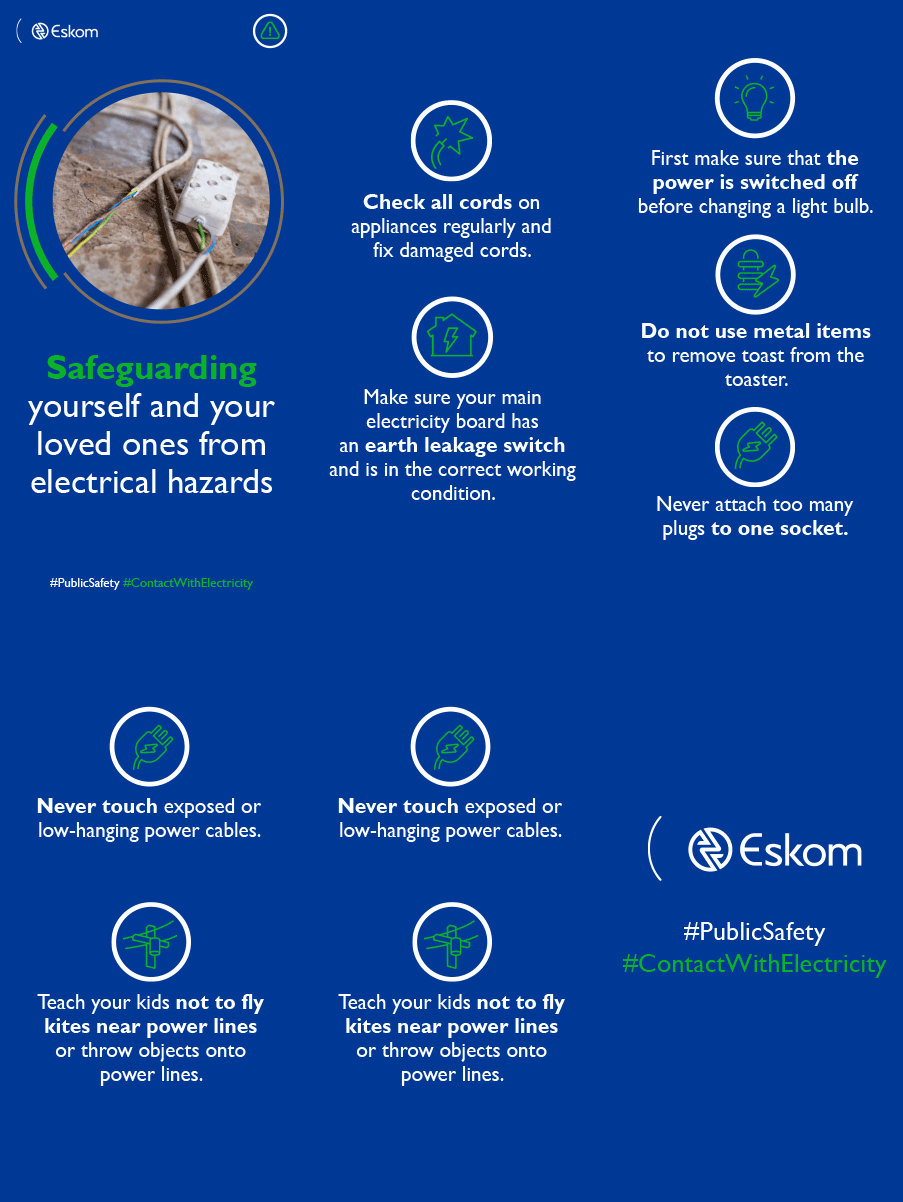
It might sound like I’m exaggerating here, but the Samsung Galaxy S26 Ultra might just be the most complete Android phone I’ve used in the past twelve months. Usually there will be one, or two headline feature that really stands out and sets any device which graces my review desk apart, but not here. It wins you over with a set of perks that make it what it truly is. An exceptional device. After using it exclusively as my only device over the past two months, it’s clear nothing else comes close.
What I’m really getting to is that the Samsung Galaxy S26 Ultra is an unapologetic powerhouse. Let’s get into why.
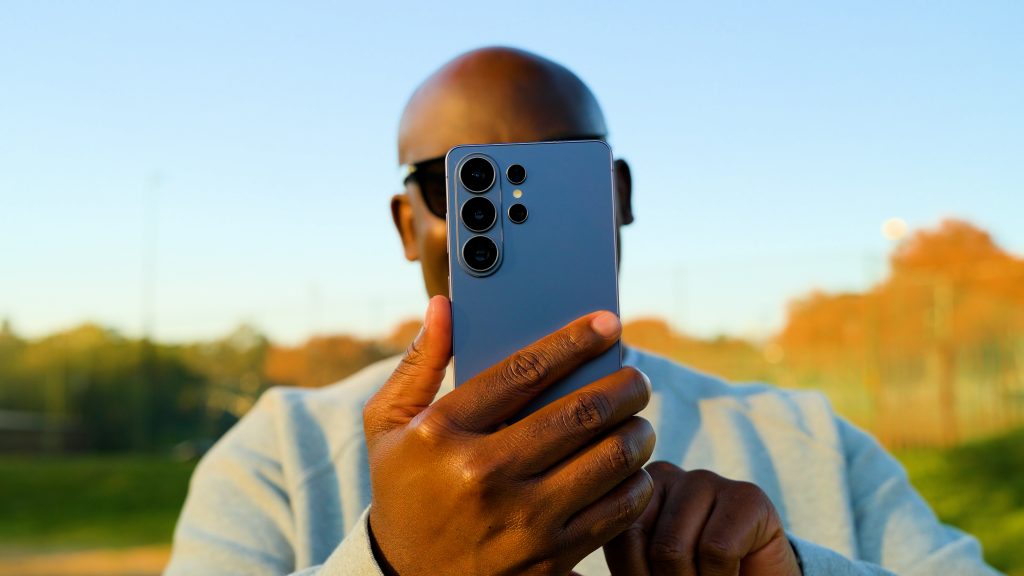
Let’s start with the looks. Samsung has gone back to an aluminium body for the Galaxy S26 range. It may read like a step backward on paper, but once you hold it in your hands, only then will you realise that it isn’t. There are benefits for the tech too. Firstly, aluminium dissipates heat a lot quicker than titanium and, when paired with the vapor chamber, prevents the device from getting heated under stress. Secondly, it handles anodization better compared to the PVD coating titanium needs. And it shows in the way its colours pop.
Speaking of colours, you get a range of them too. There’s Cobalt Violet (the one I tested), Sky Blue, White, Black and two other Samsung online exclusive tones; Pink Gold and Silve Shadow.
Earlier I mentioned the feel of the device in your hands. Here, Samsung has finally fixed those sharp, palm-digging corners I used to hate. The rounded edges are a subtle change, but they change how the phone feels entirely. The hand feel is much thinner and easier to manage in one hand. It feels nice and confident and after just one week of using the device (without a cover, I might add), it feels so natural.
The camera array around the back still sticks out and causes the phone to rock a bit when lying flat on a table or any surface. It’s worth a mention, but that’s one ergonomic compromise that’s been around for years, even with other branded devices.
The screen up front gets a Corning Gorilla Armor 2 layer mixed with ceramic for better protection and glare reduction. The rear also gets Gorilla Glass Victus 2. As drop tests usually go, I fortunately didn’t have the stomach to deliberately drop the phone, but it picked up exactly zero micro-scratches over the two months of accompanying me on a rugged off-road adventure from Johannesburg to Durban, the Midlands, Sani Pass, Lesotho, Barckley East, Graaff Reinet and Gqeberha. My backpack had everything in it. And I mean everything from keys, charging cables, snacks, a charging brick, cameras and tripods.
In Lesotho we were lucky enough to come across snow. The Galaxy S26 Ultra holds its IP68 rating, which greenlights it for accidental dops in 1.5m of water for 30 minutes. The reassurance came in handy in these conditions.
Then there’s the S Pen which lives in the bottom left corner inside of the device. It feels much thinner and more comfortable with a curved end that sits flush against the new body. Functionality on the pen hasn’t changed much but it’s still the best stylus on any phone by far. You can use it to scribble, draw, edit pictures and make notes on the fly.
The screen itself is a gorgeous 6.9-inch flat Dynamic LTPO AMOLED 2x panel with QHD+ resolution and a 120Hz refresh rate. Even when I spent my days outside, the Peak HDR brightness bumped up to 2500 nits and I never had to squint when sun was too bright.
The one standout feature is the Privacy Display built straight into the hardware rather than the aftermarket films you’d find elsewhere. It allowed me to hide the screen from whoever was sitting right next to me. I’ve used it countless times when I’m on a flight and even at events when I really need to do something urgent and sensitive. Sometimes when I had to open my X app because you never know what the timeline will surprise you with.
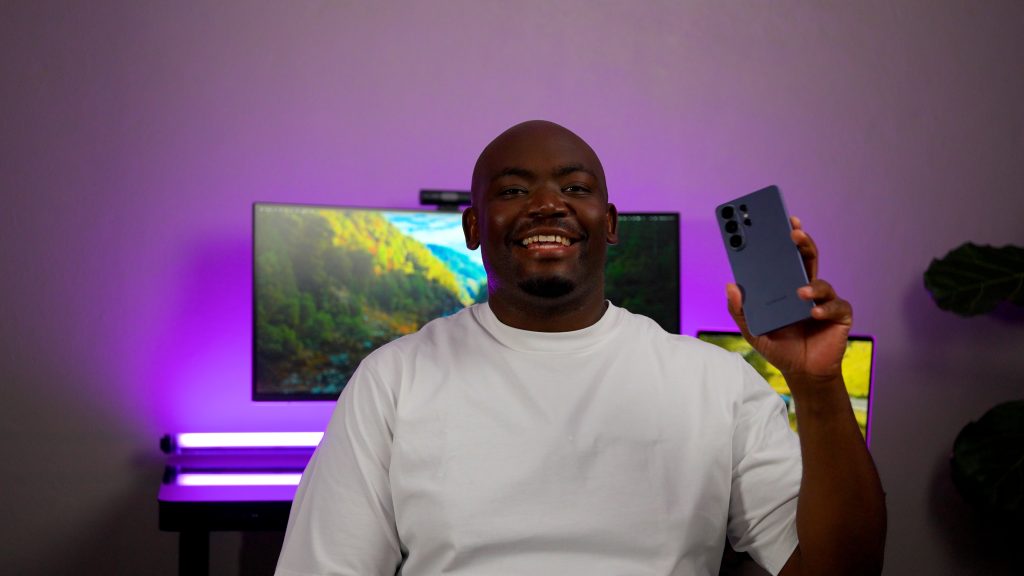
Samsung built the Privacy Display at the sub-pixel level by combining wide-view OLED pixels with narrow-beam pixel arrays. When you switch it on, the wide-view pixels turn off. Anyone looking at the screen from an angle of more than 45 degrees sees a dim, near-black display, while the person viewing it head-on can still see everything clearly. But Samsung didn’t stop there. Privacy Display has a bunch of granular controls too that allow you to either leave it on at all time or set it to specific apps or notifications.
When I first heard of the feature at launch, I was very sceptical. That’s until I got to use it and got surprised looks from the people around me.
Let’s talk about that camera array. Here you get a quad-camera layout that looks heavily familiar. I spent most of my time testing it our properly during our cross-province trek where the aperture and processing changes add up to the real gains. The main 200-megapixel main sensor does the heavy work. It features a new f/1.4 aperture, up from f/1.7 seen on last year’s Galaxy S device. The wider aperture pulls in more light which comes in handy when capturing content at night or in any low-light environment like a restaurant, really.
Samsung has gotten me used to saying the word Nightography more than I should have. It sticks, to be honest. Not just in the saying, but because that f/1.4 main lens produces impressive results in terms of colour realism and surface details. I used it quite extensively at night during the trip, and before that I’d use it at the balcony at work when I’m working late nights. What I see from up here is the beautiful Sandton skyline with Hotel Sky and The Leonardo taking centre stage. The image comes out cleaner with the bright points of distant neon lights and windows staying crisp.
That doesn’t mean it doesn’t perform during daylight. The very same 200-megapixel sensor defaults to a 12-megapixel shot that’s incredibly clean, crisp and detailed. You can still switch over to the 200-megapixel setup though, which gives off even more detailed results that you can crop into with ease. What I did notice though is that the 200-megapixel results carry a little bit of noise.
If you want to take things further, the two telephoto lenses are where the fun is at. Here you get the 3x lens which works wonders in portraits and quick shots for social media use. The 5x telephoto lens is the masterpiece as it pushes its aperture wider. Elsewhere there’s 100x Space Zoom and it’s the part trick that really gets things going. It works fine for reading far-off signage and bringing objects closer that the naked eye wouldn’t normally see. In front the camera gets a wider frame which makes it easy to squeeze in three friends into a frame. Or in my case, a vehicle in my background. The details are good and the skin tones are handled with immense clarity too.
Then there’s the Horizon Lock video mode which genuinely impresses. At one press of a button, your video picture and subject matter remains in focus regardless of whatever sudden movements or shakes your hands make.
Underneath all that glass and aluminium you’ll find the highly customized Snapdragon 8 Elite Gen 5 for Galaxy silicon which handles everything you throw at it whether its AI through Gemini, capturing 8K content on the go, with buttery smooth agility without a stutter. For those into specifics, you get fast UFS 4.0 storage and either 12 GB or 16 GB of RAM to go with it. All of that allows apps to snap open at the tap and the camera to open up instantly ready to capture in 8K.
The Samsung Galaxy S26 Ultra ships running Android 16 with One UI 8.5 baked on top. With it comes Google’s seven years of major OS and security updates, which means your phone is covered for the long haul. The UI itself genuinely isn’t bad. It’s most probably one of the only Android UI’s that I really like. I do hope Samsung updates this over time.
The battery remains the trusted 5000 mAh, the same capacity as previous Ultra models. On paper, that may seem modest, but in everyday use it delivers solid performance. On a heavy day of countless emails, document editing, picture and video editing, 5G use and maps, I averaged between 6 and 7 hours of screen-on time and I’d only charge it at night. The welcome addition of 60W wired charging also reduces the wait when you need to top it up before heading out. To put it into perspective, it would take me about 50 minutes to charge the device from near dead to full. Meanwhile, wireless charging has been bumped up to 25W on the Qi 2.2 standard. Magsafe doesn’t come standard here and you’d have to buy a specific magnet-equipped case which is a bit a let-down.
The big question remains, should you buy yourself the Samsung Galaxy S26 Ultra? In the grand scheme of things, Samsung has establish the Ultra formula and given us a device that’s been improved year-on-year without fail. You get an improved aluminium frame, a faster chipset and clever baked-in tech like that Privacy Display and AI features that push the envelope even further. And after spending months with the phone, I can confidently say if you want a device that does everything, this is definitely the one to get.
The Samsung Galaxy S26 Ultra is priced from R30 999.


You might also like


More from Featured

Sony Drops 3 New Punchy, Bass-Heavy Speakers Just in Time for Summer
Almost any South African will tell you that nothing goes better than the sun, braai and banging tunes on a …

More Dealerships On The Cards For Volvo Cars South Africa
At an exclusive Volvo Cars Track Experience held at the internationally accredited multi-disciplinary Gerotek Testing Facilities located west of Pretoria …

Big boost for South Africa’s AI talent pipeline
South Africa's AI talent pipeline just received a major boost thanks to partnership by Vodacom and the University of Johannesburg …